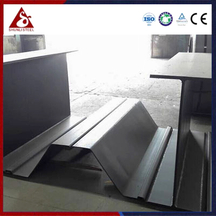
Steel sheet piles are steel sections with interconnected edges (interlocks) that form continuous retaining or watertight walls. They are widely used in both permanent and temporary projects like wharf construction, foundation pit support, and cofferdams due to their high strength, ability to penetrate hard soil layers, good water resistance, and reusability .

Main Types and Characteristics
Based on the manufacturing process, steel sheet piles are primarily divided into cold-bent steel sheet piles and hot-rolled steel sheet piles .Cold-bent steel sheet piles are formed by continuously roll-forming relatively thin steel plates (typically 8mm~14mm thick). Their main advantages are lower production costs and flexible length control. However, they have limitations such as poorer sealability at the interlocks and a tendency to tear, thus they are often used as a supplementary material in construction projects .Hot-rolled steel sheet piles are formed by rolling at high temperatures. They feature standardized dimensions, superior performance, and tightly interlocking joints that provide excellent water tightness, making them the dominant product in engineering applications. The technical difficulty and production costs are higher compared to cold-bent piles .In terms of cross-sectional shape, the main types include:
U-type Sheet Piles (Larssen type): This is the most widely used form. Its cross-section provides high lateral stiffness and excellent bending resistance, and the interlock connection is tight, offering significant water retention. They are generally used for wharf seawalls, revetments, and support for deep foundation pits .
Z-type Sheet Piles: The interlocks are symmetrically distributed on both sides of the neutral axis. This design offers a higher sectional modulus and weight ratio, providing greater strength for the same weight compared to U-shaped piles. They are suitable for high-demand wharf walls, revetments, and support structures, but their production and installation are more complex .
Straight Web Sheet Piles: Their cross-section is flat. They offer good water resistance and are easy to drive into the soil, but their lateral bending stiffness is relatively low. They are suitable for projects with good soil conditions and shallow foundation pits, or as part of composite walls .
H-type and Tubular Sheet Piles: These possess the largest sectional modulus and can withstand extremely high loads, making them suitable for deep-water hydraulic structures or support structures under high loads. Tubular sheet piles have excellent force-bearing performance and are often used in permanent engineering structures .

Key Selection Factors
Choosing the right sheet pile requires a comprehensive consideration of several factors to ensure project safety and cost-effectiveness.
Engineering Requirements: The project's nature—whether it's permanent (e.g., dock wall) or temporary (e.g., excavation support)—directly influences the choice. Permanent works may prioritize durability and high performance (often favoring hot-rolled piles like Z-type or H-type), while temporary works might focus more on economy and reusability (where U-type piles are often suitable) .
Geological Conditions and Loads: Soil properties are crucial. In soft soil, sheet piles with good bending resistance are needed to withstand lateral pressure. In harder soils, penetration ability must be considered. Analysis of earth pressure, water pressure, and other potential loads is essential .

Depth of Excavation: This determines the required length and sectional modulus of the sheet piles. Shallow pits may use U-type sheets, while deeper pits require higher-strength sections, possibly with additional support systems .
Water Tightness Needs: The required level of seepage control affects the choice. Projects demanding high water tightness, especially those near existing buildings, benefit from hot-rolled piles with their tight interlock seals .
Economic Considerations: Factors like initial material cost, potential for reuse (sheet piles can be reused 20-30 times in temporary works), and construction efficiency all play a role in selecting the most cost-effective solution .
In summary, U-type sheet piles are often the preferred choice for general applications due to their balanced performance and cost. For projects requiring higher strength and stiffness, Z-type piles offer an efficient solution. For the most demanding environments, H-type or tubular piles should be considered. Straight web piles are suitable for secondary retaining elements or shallow trenches. A rational selection not only ensures project safety but can also optimize economic benefits